How Much Money Does It Take to Justify a Family Office?

Guest Blog by Tommy Mayes, TIGER 21 Family Office Chair
If I had a dollar for every time I’m asked, “How much money do I need to justify establishing a single family office?” I’d have quite a few dollars. (Although not enough to justify a family office on its own.)
I’ve worked with families at $100 million who genuinely needed the institutional infrastructure of a single family office—and others with much more significant wealth who outsourced everything.
The idea that there’s a specific number to justify the formation of a single family office is one of the most persistent misconceptions in the family office world.
In reality, the threshold is rarely dollars alone. It’s the combined weight of scale and structural complexity across assets, entities, and stakeholders. The difference is not the size of the balance sheet. It’s the “why” behind the structure.
And that leads to the real question:
Why do you think you need a family office?
It’s Not Just About Scale. It’s About Complexity.
When people ask about minimum wealth threshold for forming a single family office, they’re usually looking for a clean number.
$100 million. $200 million. $300 million. $500 million. Or more.
Here’s why that doesn’t work:
It’s not just about scale. It’s the interaction between scale and complexity that drives the need for infrastructure.
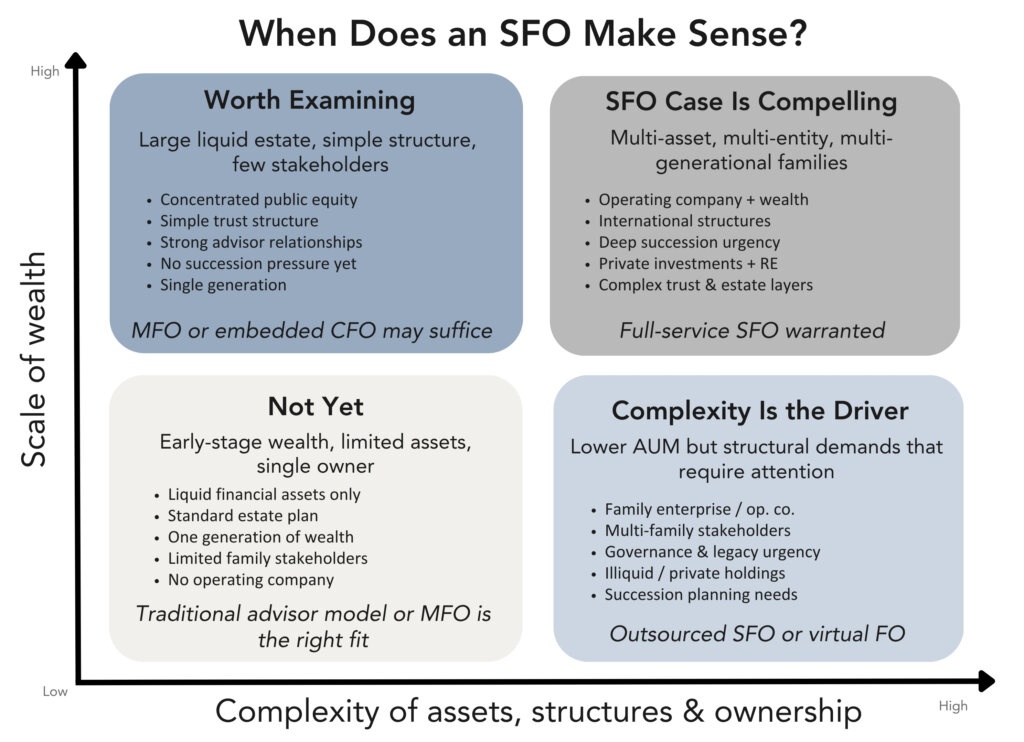
Let’s take a look at how that could play out across a few different scenarios. I developed the below chart to illustrate the interaction between the amount of wealth a family has and the complexity of their assets and ownership. Recognize that it’s a directional concept, not a math exercise.
Scenario 1: Not Yet
In early-stage wealth—with limited assets that are largely liquid and a single generation of wealth—a single family office likely doesn’t make sense. A traditional advisor model or multi-family office (MFO) is likely the right fit.
Scenario 2: Worth Examining
You can have substantial scale with very little complexity—a straightforward portfolio managed externally by an external advisor, for example. In that case, a full single family office may add unnecessary overhead. Depending on the scale, an MFO or an embedded company CFO might suffice.
I’ve seen this play out more than once: families with straightforward +/-$400M portfolios with no need for the overhead.
Scenario 3: Complexity as the Driver
You could also have lower scale with significant complexity—a family enterprise that’s an operating company or wealth with multi-family stakeholders. In this case, a hybrid single family office structure with most roles outsourced might be the way to go.
Scenario 4: SFO Case Is Compelling
The sweet spot for a single family office lies at the intersection of scale and complexity. I’m talking about multi-asset, multi-entity, multi-generational configurations with complex trust and estate layers. That combination creates a need for the infrastructure of a single family office.
As you can see, the decision hinges less on the scale of the wealth and more on how it’s structured, owned, and stewarded.
Even if a family falls in that sweet spot above—high scale, high complexity—I think it’s still important to consider their “why” before moving forward with a single family office.
The “Why” of Your Family Office Matters
When I’ve asked families why they’re considering establishing a single family office, the answers rarely center on prestige or image. In fact, I’ve never encountered a family that formed one for that reason. Their motivations tend to be more practical and more enduring.
I think the case for “why” a family office is worth considering can be organized into three categories:
- Legacy – what it protects and extends
- Strategic – what it enables
- Functional – what it does
In my experience, families often start with functional reasons—but the enduring value of a family office is almost always rooted in legacy.
In more detail:
Legacy Reasons for Establishing a Single Family Office
• Creates a succession management vehicle
• Acts as a mechanism for aligning values and mission across family and business/investment
• Offers a platform for intentional stewardship
• Acts as an organizing body to build and maintain family unity around a common purpose
Strategic Reasons for Establishing a Single Family Office
• Accommodates a multi-generational investment horizon
• Creates business continuity structure
• Fosters leadership development (both for family and non-family)
• Establishes a governance architecture for the family enterprise
Functional Reasons for Establishing a Single Family Office
• Centralizes control and preserves confidentiality
• Creates a formal delegation and execution framework
• Offers investment access and customization
• Facilitates tax and estate planning and administration
• Delivers consolidated oversight and risk management
In other words, establishing a single family office is rarely driven by a single issue.
It’s about institutionalizing decision-making and protecting long-term capital.
There’s a quote out there, often attributed to David Rubenstein, co-founder of the Carlyle Group: “If you can’t explain where your money is and what it’s doing, you probably need professional infrastructure around it.”
Whether or not he actually said it, that observation captures the spirit of the decision.
At a certain point, the complexity of family wealth begins to resemble an operating enterprise. When that happens, families often benefit from building something that looks and functions like one.
There Is No Single Answer—and That’s the Point
When I first shared an earlier version of this framework, I received several comments from professionals in the multi-family office world. They thought the question of “How much money do I need to justify a single family office?” overlooked the possibility of hybrid or outsourced family office solutions.
It doesn’t.
If anything, the takeaway is the opposite: There is no single answer to the question that inspired this post, and there’s no single solution for managing multi-generational wealth.

Families should evaluate the full spectrum of family office structures—single family office, multi-family office, hybrid, outsourced, or some combination—and choose the one that best aligns with their goals.
Are there more ideal scenarios along that sliding scale of wealth and complexity? I’d argue yes, as long as the structure you choose serves your family’s “why.”
When these types of conversations happen in a thoughtful, peer-rich environment, families often discover that the answers to their questions are more nuanced—and more personal—than any dollar threshold could capture.
There is no single answer—because this isn’t a question about wealth.
It’s a question about how a family chooses to organize, govern, and sustain its wealth.
About Tommy Mayes
Tommy Mayes is a Family Office Chair for TIGER 21. He is an accomplished founder, executive, board director, and investor with over three decades of leadership in wealth management, family offices, and regulated financial institutions. Tommy’s board and leadership experience spans trust companies, banks, insurance carriers, and multi-generational holding companies. As a single family office CEO, he has guided families through succession planning, trust company formation, and estate transitions. Tommy has also successfully transformed single family offices into a multifamily office and serves as board chair and equity general partner in Blueprint Investment Partners, stewarding over $3.5 billion in client assets. Tommy is passionate about maintaining best practices in family office operations and strategic oversight and combines hands-on operational leadership with boardroom strategy. Tommy and his wife, Katie, reside near Orlando and have three grown children.
About TIGER 21
TIGER 21 is an exclusive global community of ultra-high-net-worth entrepreneurs, investors, and executives.
Explore the TIGER 21 Member ExperienceMember Insight Reports

Download the Asset Allocation Report to see the latest Member portfolio data.
Download ReportLife After Selling a Business: What to expect, what you might not expect, and what’s next.
View the Report
Family Office


Family Office

Member & Chair Insights

Family Office


Family Office