How Wealth Creators Think About Risk Reduction

Over a lifetime of wealth creation, risk appetite evolves. For an entrepreneur building a first enterprise, a willingness to accept uncertainty is central to ambition, with the pursuit of the upside justifying exposure to the downside. However, for an established founder or business leader whose focus is broadening towards legacy, philanthropy, and the transfer of wealth, the question of calibrating risk tolerance becomes more nuanced.
Wealth creators with preservation in mind may rethink their approach to risk, with an eye toward protecting the capital key to long-term family objectives, while retaining sufficient capacity to pursue future opportunities.
For wealth creators navigating this transition, this article approaches the different ways founders, builders, and leaders approach risk once they’ve reached a certain level of success.
When Do Wealth Creators Start to Reconsider Their Risk Exposure—and Tolerance?
For those who have achieved significant success, there comes a moment when the definition of success changes. The focus on building wealth and capital may remain, but other ambitions— such as diversifying business interests, establishing a more intentional family purpose, focusing on health and wellbeing, and creating wealth succession plans—come to the forefront. Success may become less about accumulation and more about the deploying wealth in pursuit of a life well lived.
In this phase, the challenge becomes balancing these priorities: maintaining an appetite for opportunity while managing risk and ensuring that capital remains aligned with what matters most.
TIGER 21 supports Members at these moments of transition and transformation in several ways.
How Does TIGER 21 Help Members Assess Their Appetite for Risk?
Every first-year TIGER 21 Member completes a Portfolio Defense®. During their Portfolio Defense, each Member has the opportunity to examine their investments and finances, alongside all the other aspects of their life, within a small Group of trusted peers. Members ask a series of day-of questions to their Group, which may include queries around taking risk off the table.
In the TIGER 21 Personal Board of Advisors webinar, Nashville Chair Elise Mitchell shared an example of one of these day-of questions, in which a Member asked: “Should I sell the business I built?”
The Group probed deeper, asking about the motivations at play. Was this about taking chips off the table to reduce his personal risk? Or was the Member looking for something else—a new challenge or simply permission to move on?
The idea of a partial exit came up—taking some chips off the table and leaving the rest in place. The Group also brought up an additional perspective for consideration: that founders may regret selling less if they have purpose guiding their lives. Finally, the Group observed the clear enthusiasm and joy the Member shared while talking about their business, yet another angle to consider.
Ultimately, a TIGER 21 Member who walks into their monthly Meeting asking, “Should I sell?” should expect the question to spark a discussion that yields varying perspectives, all of which can offer new angles on rebalancing a portfolio.
What Signals Might Prompt Wealth Creators and Investors to Reduce Risk?
Within the TIGER 21 community, we see some broad themes that might cause a Member to rethink their risk exposure.
Trigger 1: A Liquidity Event
A liquidity event, such as selling a business, converts concentrated risk into liquid capital. This can leave a wealth creator with questions about how to reinvest that capital, including how much should remain committed to the pursuit of growth and how much should be focused on longer-term preservation.
For some entrepreneurs, being confronted with a large amount of liquid capital can feel like a significant moment. Some, motivated by entrepreneurial drive, are tempted to invest immediately, while others may delay action out of fear of making the wrong decision. Still others may turn over this new liquidity to a wealth manager.
Talking through this topic with a peer group—especially one that includes other post-exit founders—can put all the options on the table, enabling a more informed decision as to how to deploy that capital.
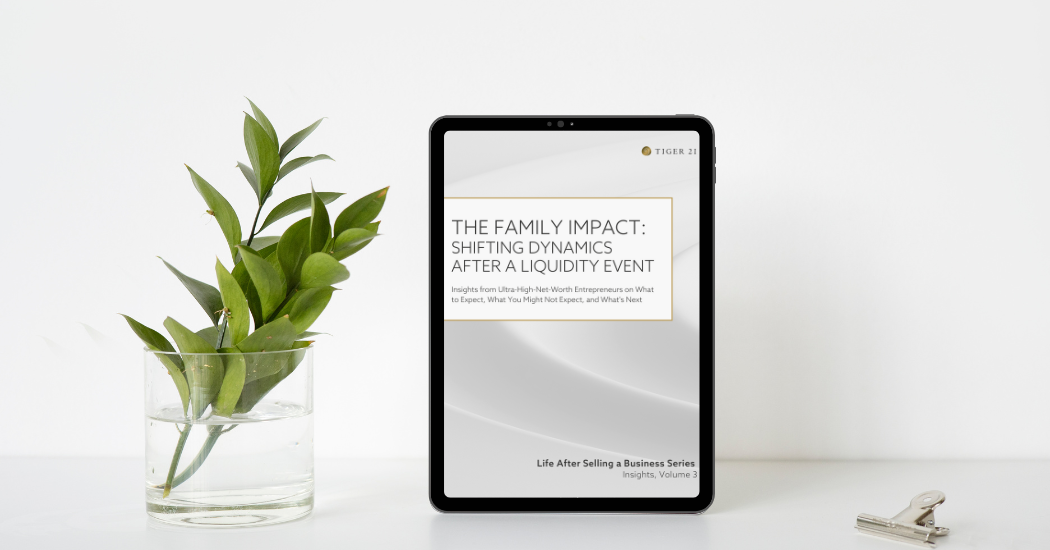
Life After Selling a Business: Stories from TIGER 21 Members Many entrepreneurs find themselves navigating a series of challenges and opportunities after selling their businesses, including a shift in identity and daily purpose, changes in family relationships, and finding that next mountain to climb. The TIGER 21 Life After Selling a Business Series reflects on the personal and financial transitions that follows a liquidity event, offering post-exit insights from TIGER 21 Members. |
Trigger 2: A Health Event
A significant health event can alter risk appetite almost overnight. It can also reframe an investor’s portfolio goals. A desire to maximize returns over the next two decades may transform into an intention to provide sufficient resilience, liquidity, and peace of mind for a wealth creator, their family, and their interests in the years ahead.
Trigger 3: A Fresh Perspective from a Trusted Advisor or Peer
Sometimes, a single sentence from an advisor or a peer can alter one’s attitude toward risk. For a wealth creator with significant capital tied up in low-risk, low-return investments, a well-placed comment from a peer could reshape long-held beliefs about “appropriate” levels of risk. Or, in the case of a Portfolio Defense, seeing a peer’s allocations might trigger a realization that a rebalancing may be warranted.These examples illustrate the power of perspective. Seeing how other seasoned investors make decisions and gaining an inside look at their investment philosophies can spark a new line of thinking.
Trigger 4: A Family Transition
Family transitions can also shape how wealth creators think about risk. The Next Gen reaching adulthood, a first grandchild, or a death in the family can generate thoughts around wealth preservation vs. risk. In some cases, these events may even inspire wealth creators to think beyond G2 and G3 and into making moves that create multi-generational success for years to come.
Trigger 5: A Downturn
An economic downturn can suddenly reveal unrealized risk to an investor. It can also test an investor’s risk tolerance. For example, an investor who assumed their portfolio was moderately exposed can discover during a downturn that their position was riskier than they believed. Or, they may discover that they simply don’t have the stomach for the level of risk their portfolio represents. These scenarios can trigger a rebalance to reduce risk.
What Can Delay the Decision to De-Risk a Portfolio?
Emotional attachment, overconfidence, and the fear of missing out can all make it harder for entrepreneurs and wealth creators to step back from riskier investments.
Patterns of habit and identity can be the most difficult to spot. Someone who spent decades thinking like an entrepreneur, for example, most likely does not switch off that instinct the day they sell their company. Instead, their habits—ones that built significant wealth—may simply continue into the next phase, motivating them to take on riskier investments.
TIGER 21 Members looking to level-set their risk tolerance can gain valuable perspective from the experienced entrepreneurs and investors in their Group. They can also leverage their Group as a board of advisors to help vet investing decisions, gathering input from Members of varying backgrounds, expertise, and risk tolerance.
What Does Wealth Preservation Actually Look Like in Practice?
Ask 15 TIGER 21 Members what “wealth preservation” looks like to them, and you’ll get 15 different answers. That’s one of the benefits of belonging to TIGER 21—the ability to dive deep with 12-15 peers and hear their individual philosophies on how they manage their wealth and the responsibilities that surround it.
When it comes to having enough liquidity to sustain a family’s lifestyle, meet commitments, and maintain the course through changing economic and market conditions, some TIGER 21 Members think in terms of a “cash buffer:”
- For some, this means holding 12 to 24 months of expenses (or more) as a buffer, regardless of overall net worth.
- Others choose, instead, to look at cash as a percentage of their total portfolio.
Through the years, TIGER 21 Asset Allocation Reports have reported Members holding anywhere from 7–14% of their total allocations in cash. The Q2 2026 edition showed cash allocations at 7%, the lowest level since TIGER 21 began collecting this data in 2007.The exact amount of cash an investor should hold depends on many factors including lifestyle, financial obligations, and comfort levels, not solely the scale of wealth itself.
Wealth creators focused on preservation should also consider their drawdown tolerance. It’s particularly important to reevaluate this threshold when shifting from an accumulation phase to one more focused on preservation, since time horizons for potential recovery can change. Drawdown tolerance, like risk tolerance, also comes with personal and psychological considerations that wealth creators need to be aware of.
For the majority of the TIGER 21 community, prioritizing wealth preservation doesn’t mean becoming passive. Preservation still requires active investing decisions. For example, after joining the TIGER 21 community, some Members begin to diversify their portfolios. Those who came into TIGER 21 heavily invested in an asset class that built their wealth take advantage of the learning opportunities in the community to begin investing in additional classes, such as private equity, real estate, and fixed income. These diversifications can help build an all-weather portfolio, designed to weather any economic storm.
Turning the Focus to Wealth Preservation
The shift from growth to wealth preservation may happen gradually, and it rarely materializes in a single decision. Instead, it may simply evolve as a wealth creator’s priorities and world view shifts toward the long term.
The investors who navigate this transition most effectively focus less on the “how” and more on the “why”—the purpose behind their wealth and what they hope it will create for themselves, their families, and the generations beyond.
About TIGER 21
TIGER 21 is an exclusive global community of ultra-high-net-worth entrepreneurs, investors, and executives.
Explore the TIGER 21 Member ExperienceMember Insight Reports

Download the Asset Allocation Report to see the latest Member portfolio data.
Download ReportLife After Selling a Business: What to expect, what you might not expect, and what’s next.
View the Report


Member Experience

Member & Chair Insights
Member & Chair Insights


Family & Legacy Planning